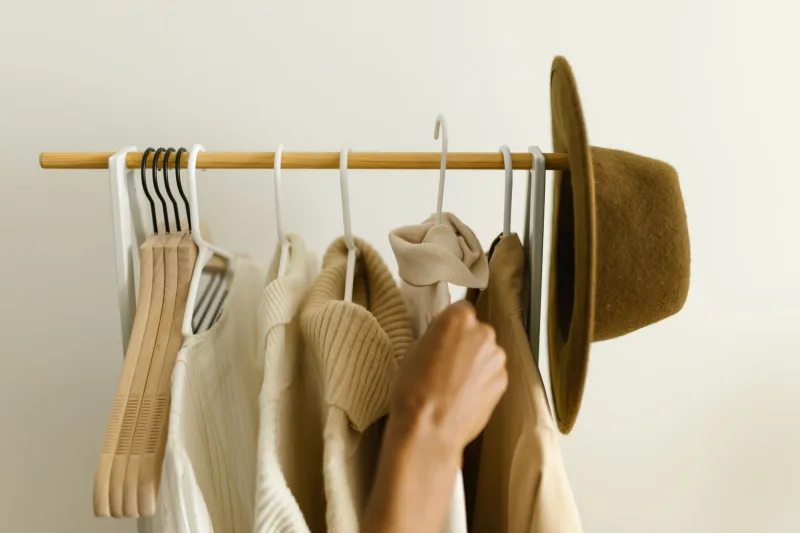
The Capsule Wardrobe Is Not the Hero Story Fashion Sold You

Somewhere between the fourth flat-lay Instagram post and the seventeenth YouTube video promising you that 37 pieces will change your entire life, a lot of us bought in. Hard. The capsule wardrobe became the gold standard of having your act together — the fashion equivalent of meal prepping on Sunday and actually sticking to it. Minimal, intentional, effortless. The dream.
Except here's the thing nobody really talks about: for a lot of people, building a capsule wardrobe didn't simplify anything. It just swapped one kind of stress for another.
The Promise vs. The Reality
The capsule wardrobe concept has been around since the '70s, but it really exploded in the last decade as minimalism went mainstream. The pitch is genuinely appealing — own fewer things, make better choices, spend less time staring into the void of your closet every morning. Who wouldn't want that?
But the execution? That's where things get messy.
Because the moment you commit to "only keeping what's essential," you have to define essential. And that definition shifts constantly depending on your job, your social life, the season, your mood, whether you got invited to a rooftop thing on Friday, and about a hundred other variables that no capsule wardrobe formula accounts for. Suddenly you're not just getting dressed — you're auditing your entire lifestyle against an imaginary rubric you found on Pinterest.
That's not freedom. That's homework.
Decision Fatigue in Reverse
Here's the psychology piece that gets glossed over: decision fatigue is real, and yes, having too many choices can be exhausting. That's the science capsule wardrobe advocates lean on heavily. But there's a flip side that doesn't get nearly enough airtime.
When you've stripped your wardrobe down to the bare minimum, every single item carries enormous weight. You're not just picking a shirt — you're validating a purchase decision, confirming your identity, and proving to yourself that your curated system works. That's a lot of pressure to put on a beige linen button-down.
For people who are already anxious or perfectionistic, the capsule wardrobe can become a new arena for that energy to play out. Instead of too many options causing stress, now it's the fear of getting the right options wrong. You spend more time researching "the perfect white tee" than you ever did just grabbing one off the rack and moving on with your day.
The 'Versatile Neutral' Trap
Let's talk about the aesthetic that quietly comes with most capsule wardrobe advice: a whole lot of beige, white, grey, and navy. The logic is that neutrals mix and match easily, which is true. But it also means that if you're someone who genuinely loves color, prints, or anything with a little personality, you're being asked to edit that part of yourself out in the name of efficiency.
And that's a weird trade-off when you think about it. Fashion is one of the most personal forms of self-expression most of us engage with daily. Telling someone that their wardrobe should look like a luxury hotel room — calm, coordinated, and completely devoid of anything surprising — isn't a style upgrade. For a lot of people, it's a personality downgrade.
The capsule approach assumes that everyone's style goal is "effortless minimalism." But some people's style goal is "I want to look like I walked out of a vintage market in New Orleans" or "business casual with a little chaos" or "honestly whatever I feel like today." Those are valid goals too.
One Size Has Never Fit All
Here's the part that really gets overlooked: your wardrobe needs to fit your actual life, not an idealized version of it.
A capsule wardrobe built around crisp white shirts and tailored trousers makes total sense for someone who works in a formal office environment and spends weekends at wine bars. It makes zero sense for a kindergarten teacher, a personal trainer, someone who works from home three days a week, or anyone whose life involves a wide variety of contexts that demand genuinely different clothes.
The rigid capsule formula doesn't account for climate variability — ask anyone who lives somewhere with actual seasons how well a single lightweight trench coat is working out for them in February. It doesn't account for size fluctuations, which are a completely normal part of being a human body. And it definitely doesn't account for the fact that sometimes you just want to wear something fun that doesn't "go with everything."
A More Honest Alternative
None of this means minimalism is bad or that editing your closet is a waste of time. Owning things you actually wear and feel good in is genuinely a solid goal. The issue is the rigidity — the idea that there's a formula you need to follow and a specific number you need to hit.
A more realistic approach? Think about your wardrobe in terms of your actual weekly life rather than an abstract ideal. What do you actually do most days? What do you wear most often? Start there. Keep what works across those real scenarios, let go of what doesn't, and stop punishing yourself for owning a sequined top you only wear twice a year. If it brings you joy when you wear it, it's earning its spot.
You can also give yourself permission to have "zones" instead of one unified capsule. A work zone, a weekend zone, a going-out zone. They don't have to be perfectly coordinated with each other. They just have to work for the version of you that shows up in each of those situations.
Stop Optimizing, Start Wearing
The capsule wardrobe trend sold us on the idea that getting dressed could be a solved problem — a system so perfectly engineered that it runs on autopilot. But getting dressed isn't a problem to be solved. It's a daily, small, kind of fun act of figuring out who you are and how you want to show up.
Some days that looks like a perfectly coordinated neutral outfit. Some days it looks like something you definitely couldn't explain to a minimalist influencer. Both are fine. Both are you.
The goal was never to own fewer things. The goal was to stop feeling bad about what you own. And no capsule formula is going to get you there — but actually paying attention to what makes you feel like yourself just might.